Higher education has undergone a massive transformation over the past decade. Traditional pathways—which often involve taking four or more years of full-time, on-campus classes at tens of thousands of dollars per year—are no longer the only way to earn an accredited bachelor's degree. As tuition rates continue to climb, adult learners, working professionals, and proactive high school students are increasingly turning to alternative college credit solutions to lower costs and speed up graduation timelines. Among the most popular options available today are college saver / accelerator plans.
These subscription-based educational models allow students to complete college-level coursework online at their own pace, earn recommended transfer credits, and apply those credits toward degree programs at accredited universities. By shifting the structure of learning from rigid semester schedules to flexible, mastery-based modules, college saver / accelerator plans have redefined how modern students approach higher education.
This comprehensive guide explains how these platforms function, how credits transfer, and how you can leverage them to save thousands of dollars on your degree.
What Are College Saver / Accelerator Plans?
At their core, college saver / accelerator plans are monthly or annual subscription programs that grant students access to a broad catalog of college-level online courses. Instead of paying tuition per credit hour—which at standard four-year institutions can range from $300 to over $1,000 per credit—students pay a flat recurring membership fee. While subscribed, learners gain access to learning materials, video lessons, chapter quizzes, and final evaluations designed to fulfill specific degree requirements.
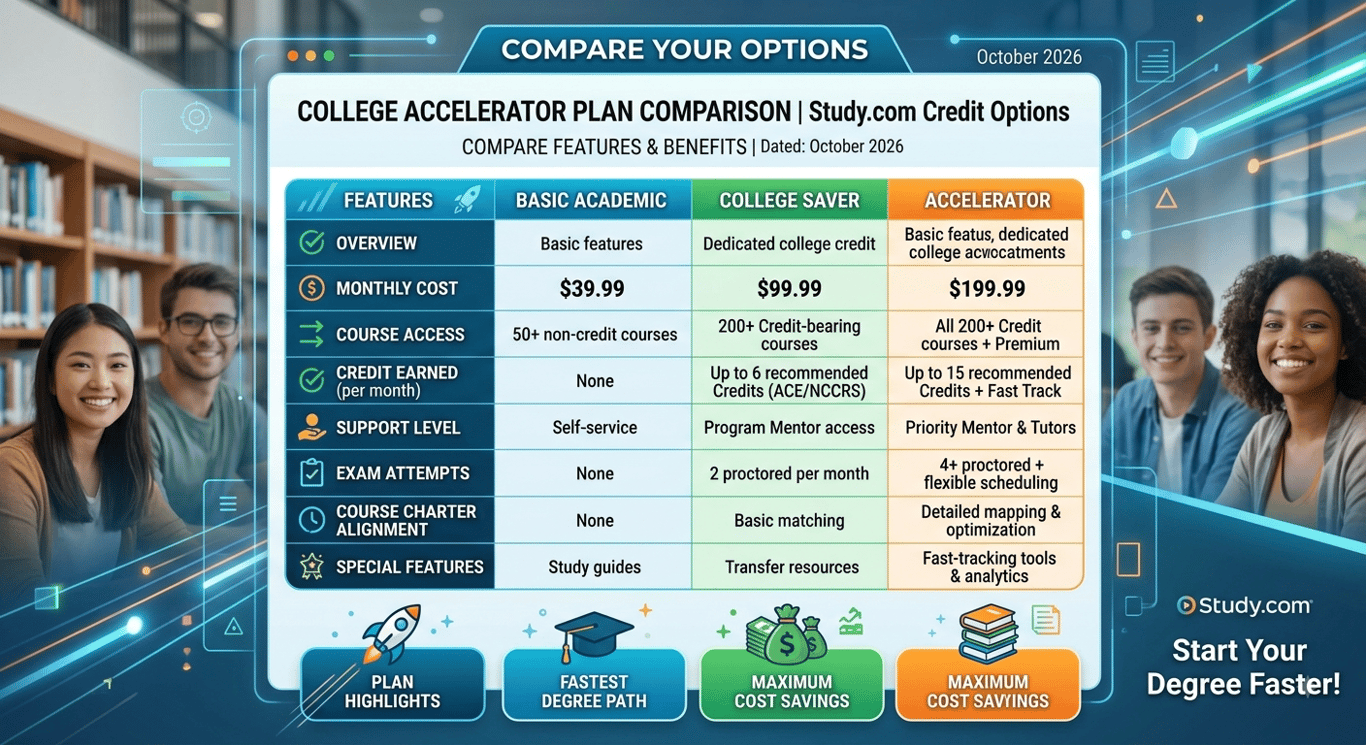
To have Study.com College Saver explained simply, it is a subscription tier specifically engineered for college credit generation. While basic educational subscriptions on various learning sites provide general study aid or test preparation, designated credit-bearing plans allow students to complete official assessments and earn transcripted credit hours recognized by postsecondary institutions.
Historically known in many academic communities as the Study.com Accelerator plan, this structure pioneered a streamlined method for finishing general education requirements and lower-division major courses prior to formally enrolling in a university. Today, these specialized Study.com credit plans offer over 200 courses across disciplines like business, humanities, natural sciences, computer science, and social sciences.
The Core Mechanics: How the Process Works Step-by-Step
Understanding how to navigate an accelerated credit pathway is essential for maximizing both time and financial savings. While individual platforms vary slightly in interface, the overarching process follows a structured six-step sequence:
1. Course Selection and Mapping: The student identifies required courses for their target degree program (e.g., General Chemistry, Microeconomics, or College Algebra).
2. Self-Paced Learning: Students digest bite-sized video lessons, transcript readings, and interactive practice activities. Because the material is asynchronous, motivated learners can progress through multiple chapters in a single week.
3. Formative Assessments: At the end of each chapter, students take short quizzes to test comprehension. These quizzes build toward a cumulative course grade.
4. Written Assignments and Projects: Upper-division or writing-intensive courses often require essays, research papers, or capstone projects that demonstrate comprehensive mastery of the subject matter.
5. Cumulative Final Exams: Upon completing all coursework, students take a comprehensive final exam online to verify identity and mastery.
6. Transcript Request & Credit Transfer: Upon achieving a passing grade (typically 70% or higher overall), the student requests an official transcript through credit recommendation bodies to send to their receiving college.
How Credit Recommendation and Transferability Work
A common question among prospective students is: How can an online subscription platform grant real college credit?
The answer lies in national credit evaluation frameworks. Platforms that offer college saver / accelerator plans submit their curriculum, assessment rigor, and faculty qualifications to independent credit recommendation organizations. The two primary bodies in the United States are:
- American Council on Education (ACE Learning Evaluations): ACE reviews non-traditional educational experiences and provides credit recommendations that are considered by more than 2,000 colleges and universities nationwide.
- National College Credit Recommendation Service (NCCRS): Similar to ACE, NCCRS evaluates courses from non-collegiate organizations and recommends them for academic credit at hundreds of participating institutions.
When a receiving university accepts ACE or NCCRS recommendations, they equate the platform's completed course directly to one of their native catalog offerings.
To make this seamless, many partner universities establish a formal course charter or articulation agreement. A course charter explicitly details which online platform courses satisfy specific degree requirements at the university. For example, completing "BUS 101: Introduction to Business" on an accelerator platform might automatically satisfy "MGMT 1001" at a partner institution like Western Governors University (WGU), Southern New Hampshire University (SNHU), or Liberty University.
Key Benefits of Using Accelerator Models
Why are tens of thousands of adult learners choosing alternative credit plans over traditional classroom environments? The advantages span financial, operational, and psychological factors:
Significant Financial Savings
The standard cost of a 3-credit college course at a public four-year university ranges between $1,000 and $1,500, while private universities can charge upwards of $3,000 to $4,500. By utilizing subscription-based plans, a dedicated student can complete 2 to 4 courses in a single month for just the monthly subscription fee (plus small administrative exam fees if additional tests are taken). This can reduce overall degree costs by tens of thousands of dollars.
Ultimate Scheduling Flexibility
Traditional higher education requires sitting through 15-week semesters with fixed lecture times. Accelerator plans allow students to learn 24/7. Working parents, full-time employees, and military personnel can study during lunch breaks, early mornings, or late nights without altering their work schedules.
Accelerated Time to Graduation
Because learning is competency-based, students do not have to wait for the rest of a class to catch up. If a student already possesses background knowledge in a subject—such as introductory psychology or basic macroeconomics—they can review the material quickly, pass the assessments, and earn credit in a matter of days rather than months.
Strategic Academic Guidance and Support
Navigating self-paced learning independently can sometimes feel overwhelming. To prevent students from taking unnecessary courses or losing momentum, leading platforms and partner universities integrate academic guidance roles.
Dedicated program mentors and student success coaches play a vital role in this ecosystem. These advisors assist students by:
- Mapping out personalized degree pathways based on target graduation dates.
- Reviewing university transfer policies to ensure every completed course fulfills a specific general education or major core requirement.
- Providing accountability check-ins to help students maintain steady progress through their monthly subscription cycles.
- Recommending specialized tutoring services or supplemental study aids when students encounter challenging subject material.
Subject Selection: Which Programs Accelerate Fastest?
A common area of inquiry for incoming non-traditional students is which programs accelerate fastest?
While speed ultimately depends on individual background knowledge and dedication, certain academic paths tend to yield significantly faster completion rates on self-paced platforms:
- General Education Core (Humanities, Social Sciences, Communications): Courses like Introduction to Sociology, Public Speaking, Art History, and U.S. History feature standardized concepts that can be mastered rapidly through video modules and targeted reading.
- Business Administration & Management: Introductory business subjects—including Marketing, Organizational Behavior, Principles of Management, and Business Law—often feature straightforward terminology and practical real-world scenarios that allow experienced working adults to accelerate quickly.
- Information Technology & Computer Science: Students who possess basic programming skills, familiarization with database administration, or network security concepts can rapidly test through lower-level IT credits.
Conversely, subjects that require extensive lab work, higher-level mathematical derivations (like Calculus III), or multi-stage capstone projects naturally require a more substantial time investment. Strategic students often knock out 10 to 15 general education and elective courses on accelerator platforms first, leaving specialized upper-division courses for their primary university.
Best Practices for Maximizing College Saver / Accelerator Plans
To get the highest possible return on investment when utilizing college saver / accelerator plans, consider implementing the following expert strategies:
- Always Verify Before Enrolling: Contact the admissions or credit evaluation office at your target university before starting a course. Confirm that the specific ACE/NCCRS course code matches your degree plan.
- Set a Daily Study Schedule: Treat self-paced learning like a job. Setting aside 1 to 2 dedicated hours every day produces far better retention and faster course completion than weekend cramming.
- Leverage Pre-Tests and Practice Quizzes: Use diagnostic tools to identify which topics you already understand and which chapters require thorough review.
- Combine Alternative Credit Sources Wisely: Many students combine online subscription courses with AP exams, CLEP tests, and prior learning assessments (PLA) to maximize the total transfer cap (often up to 75% or 90 credits) allowed by their degree-granting institution.
Final Thoughts
The modern educational landscape no longer requires students to go deeply into debt or sacrifice years of their careers to earn a respected university degree. Subscription-based credit solutions provide a flexible, affordable, and academically rigorous alternative for motivated self-starters. By understanding how credit recommendations work, partnering with dedicated program mentors, and strategically selecting transferable courses, learners can take full control of their higher education journey and reach the graduation finish line faster than ever before.