In the modern digital landscape, free trials are one of the most powerful—and underutilized—tools available to learners, professionals, and students. Whether you are aiming to pick up new skill sets, explore platform interfaces, or fast-track your college degree, a well-planned trial period allows you to evaluate educational platforms risk-free. However, without a clear roadmap, a free trial can easily slip away unutilized or turn into an unexpected charge on your credit card.
By approaching trial periods with intention, clear goals, and structured evaluation metrics, you can transform a brief trial window into a high-value learning experience.
Why Free Trials Matter for Higher Education and Online Learning
The online education space has expanded rapidly, offering courses in everything from business fundamentals and computer science to advanced humanities. While this convenience is revolutionary, course quality, interface design, and delivery formats vary wildly across providers.
Using a trial period strategically allows you to answer fundamental questions before making a financial commitment:
- Format Compatibility: Does the content rely heavily on video lectures, dense reading materials, or interactive quizzes?
- Pacing Flexibility: Can you move through modules at your own speed, or are assignments locked behind strict weekly schedules?
- Value Assessment: Does the depth of the curriculum match your personal learning objectives or academic requirements?
For students exploring competency-based platforms, testing the environment first is essential. Utilizing options like the Sophia Learning free trial offers a direct window into how self-paced education works in practice. Taking advantage of these opportunities ensures that your investments in education yield maximum return.
Setting Up Your Free Trial Strategy: A Step-by-Step Blueprint
To make the most of any trial window—whether it spans 3 days, 7 days, or a full month—you need an action plan prior to clicking "Start Trial."
Step 1: Pre-Trial Prep and Goal Setting
Before signing up, set aside dedicated study blocks in your calendar. Do not start a trial on a busy workday or right before a weekend getaway. Prepare your environment by identifying exact courses or topics you want to audit.
Step 2: Audit the Curriculum Structure
Once inside, immediately inspect the full syllabus. Look for clear module breakdowns, grading criteria, and hands-on assessments. For platforms focused on general education or college credit recommendations, check Sophia trial what included to see if complete syllabus access, sample lessons, and diagnostic tools are provided without immediate payment.
Step 3: Test Interactive Features
Don't just read the introductory page. Engage with the interactive elements, check for downloadable reference guides, and sample the practice tests to gauge the difficulty level and assessment style. Evaluating practice questions early helps you determine whether you understand the instruction style and whether the material aligns with your current knowledge base.
Step 4: Map Out Credit Transfer and Institutional Compatibility
If your goal is to transfer credits toward a university degree, verify institutional alignment during your trial. Confirm that the platform's course numbers match your target institution's transfer equivalency guides. Opportunity to try Sophia before paying gives degree-seeking students the perfect low-risk window to cross-reference course outcomes with their academic advisors.
Tailoring the Experience for Different Learner Profiles
Different types of students need different outcomes from a trial period. Understanding your specific learner profile ensures you test the features that matter most to you.
High School and Early College Students
Early academic planning can save thousands in future tuition. Utilizing structured online learning platforms during secondary school helps students build college-level study habits early. When evaluating programs like Sophia for high schoolers, families can test whether self-directed study fits the student's learning style before committing to a full subscription. It provides a structured environment to explore advanced subjects, build confidence, and potentially earn early college credit.
Working Professionals and Degree Accelerators
Adult learners balancing work, family, and education need extreme efficiency. For this group, the trial strategy focuses on speed, platform responsiveness, and mobile compatibility. Can you complete readings on your phone during a lunch break? Is the user dashboard intuitive? Testing these operational details during a trial prevents friction down the road.
How to Evaluate Course Workloads and Difficulty
Not all courses require the same time investment. One of the primary benefits of an initial platform audit is assessing workload intensity so you can plan your study schedule effectively.
When exploring self-paced platforms like Sophia Learning, learners often find a wide spectrum of course complexity. Doing research on the hardest and easiest Sophia courses during your trial allows you to structure your future study schedule strategically:
- Foundational / Lighter Workload Courses: Subjects like Visual Communications, Environmental Science, or Developing Effective Teams generally feature straightforward reading modules and multiple-choice quizzes, making them ideal for building initial momentum.
- Intensive / Higher Workload Courses: Courses such as English Composition II, Calculus, or Human Biology often involve extensive written essays, complex lab reports, or multi-step problem sets that require significant dedicated time.
By identifying which subjects fall into each category during your trial, you can balance your workload—pairing one heavier course with a lighter subject to avoid burn-out.
Avoiding Common Free Trial Pitfalls
While trial periods offer high utility, they come with potential traps if managed passively. Here are the top mistakes to avoid:
1. The Automatic Renewal Trap: Set a calendar reminder 24 to 48 hours before the trial expires. If you decide the platform isn't right for you, cancel immediately to avoid unwanted charges.
2. Passive Browsing: Don't spend your trial simply reading FAQ pages. Jump directly into core coursework, complete an introductory module, and take a diagnostic test.
3. Ignoring Support and Community Resources: Test the support ecosystem. Submit a question to customer support or check how quickly tutor assistance responds. Responsive support is a key indicator of a high-quality educational provider.
4. Over-Subscribing: Avoid signing up for multiple free trials across different platforms simultaneously. Focus on evaluating one platform at a time so you can give it your full attention.
Checklist: Maximizing Your Trial Period
Use this quick checklist to ensure you cover all necessary bases during any online learning trial:
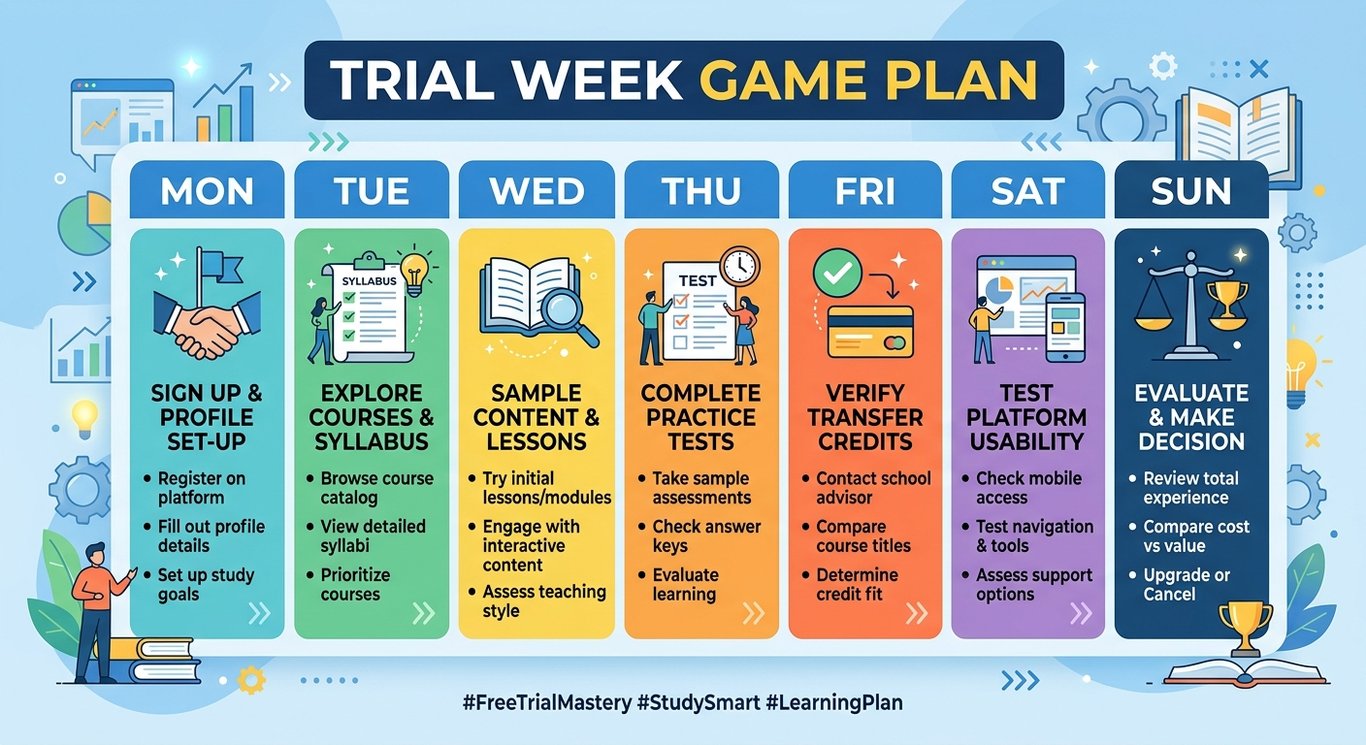
- Day 1: Register, explore the user dashboard, and set up your user profile.
- Day 1: Review full syllabi for your target courses.
- Day 2: Sample video transcripts, audio options, and digital textbooks.
- Day 2–3: Complete at least one unit quiz or set of practice tests.
- Day 3–4: Test mobile browser performance or dedicated apps.
- Day 5: Review transfer guides, articulation agreements, or accreditation details.
- Day 6: Make a clear decision: continue to paid subscription, pause, or cancel.
Conclusion: Making Informed Educational Investments
A free trial should never be viewed merely as a brief period of free access; it is an active research window. By systematically auditing course materials, testing assessment formats, evaluating workload intensity, and confirming institutional fit, you empower yourself to make smart, cost-effective decisions about your education.
Whether you are a secondary student taking your first step into higher education with options like Sophia for high schoolers, or a degree-accelerator looking to try Sophia before paying, strategic preparation ensures every minute of your trial moves you closer to your academic and career goals.